
On Thursday, September 15th, we’re hosting a tasting of ports with sales director, Harvey Roberts, from Portugal’s oldest producer of these fascinating wines, Kopke. Since 1638, this relatively unknown port house has been producing and exporting wines of superior quality for discerning drinkers around the world. This tasting will present a wonderful opportunity to experience four distinct styles of port, the techniques behind which are outlined below.
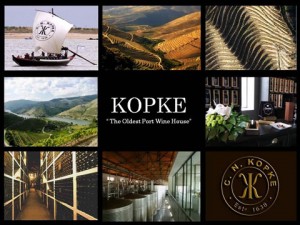 For those unfamiliar with port and its production, this is a fortified wine, initially exclusively from Portugal. It’s named after the city of Oporto, where most of the main producers have their facilities, known as lodges. Vinified from native grapes, most importantly Touriga Nacional, Port is high (20%) in alcohol, and can be soft and sweet, mellow and nutty, or fierce and tannic, depending on the production style and the vintage.
While still a fairly popular drink in Europe and the U.S., port does not have the marketshare it enjoyed in the eighteenth and nineteenth centuries, when it was the strong drink of choice of both ladies and gentlemen, upper and middle class alike. This full-flavored wine would have married well with the equally robustly flavored dishes that were so popular in Britain and its colonies. In addition, the heady aromas and high alcohol probably helped to mask less wholesome aromas that were more pervasive prior to widespread sanitation.
Grown on the steeply-terraced schisty slopes of the Douro river valley, port grapes have thick skins and can achieve high sugar levels in the fierce heat of the sun. After harvest, the grapes are crushed in large open concrete tanks known as lagares: traditionally this was done by foot, but today only around 5% is processed in this manner, as port houses have in recent years begun to experiment with various mechanical crushers. The fruit then begins the fermentation process. After 36 hours or so, the partly fermented must is fortified with a neutral 77˚ proof grape spirit known as Aguardente.
Up to this stage, all port is made in more or less the same way. It is what happens after fermentation and fortification that distinguishes the various port styles. As an overview, here are the four styles we’ll be tasting on the 15th and how they differ from one another. For more information about the class and to register, click here.
White Port
This, as the name suggests, is made from white grapes. It can be aged either in wood or in steel, depending upon the desired flavor profile. Some can be bright and fresh, others deeper in color and nutty. Both make excellent aperitifs.
Vintage Port
Produced only in the finest vintages (on average three a decade), vintage port is made from fruit selected from the best vineyard locations and harvested at optimal ripeness. The young wine is aged in large barrels, known as pipes, for a maximum of thirty-two months prior to being bottled. Because of the lack of exposure to oxygen, the wine retains its youthful color, vigor and tannins. The aging all takes place in the bottle, a process which may take forty or fifty years.
Tawny Port
Quality tawny port is aged in barrels for a minimum of four to six years, and anything up to forty. Unlike vintage port, which ages in the absence of oxygen, tawny is exposed to air via the barrel, where it slowly loses its color and picks up nutty, caramel flavors and aromas with slow oxidation. Age declarations, such as 10 and 20 year old, refer to an average age, and not to a specific vintage.
Colheita Port
This is a fascinating designation, and one only practiced by a handful of producers: Kopke is the leader in the field. Made in the same way as tawny port, Colheita is a single vintage tawny, which can be aged for up to sixty or seventy years prior to bottling. The resulting wine can be staggeringly subtle and complex, as well as generally more affordable than its vintage counterparts. This makes a great birthday gift for anyone born in the last century.

I’m a huge fan of Kopke Ports. My favorite was a 1979 Vintage I shared in Paris with a dear friend and direct descendent of Admiral Halsy. A great Kopke Port is by far the best after dinner quaff for a special occasion.
Neil
I can hardly wait for this tasting, and your post only increases my exictement! For reasons I still don’t quite understand, I have a great interest in port. I’ve tasted just a few and look forward to many, many years of tasting.
Thanks for sharing this information.